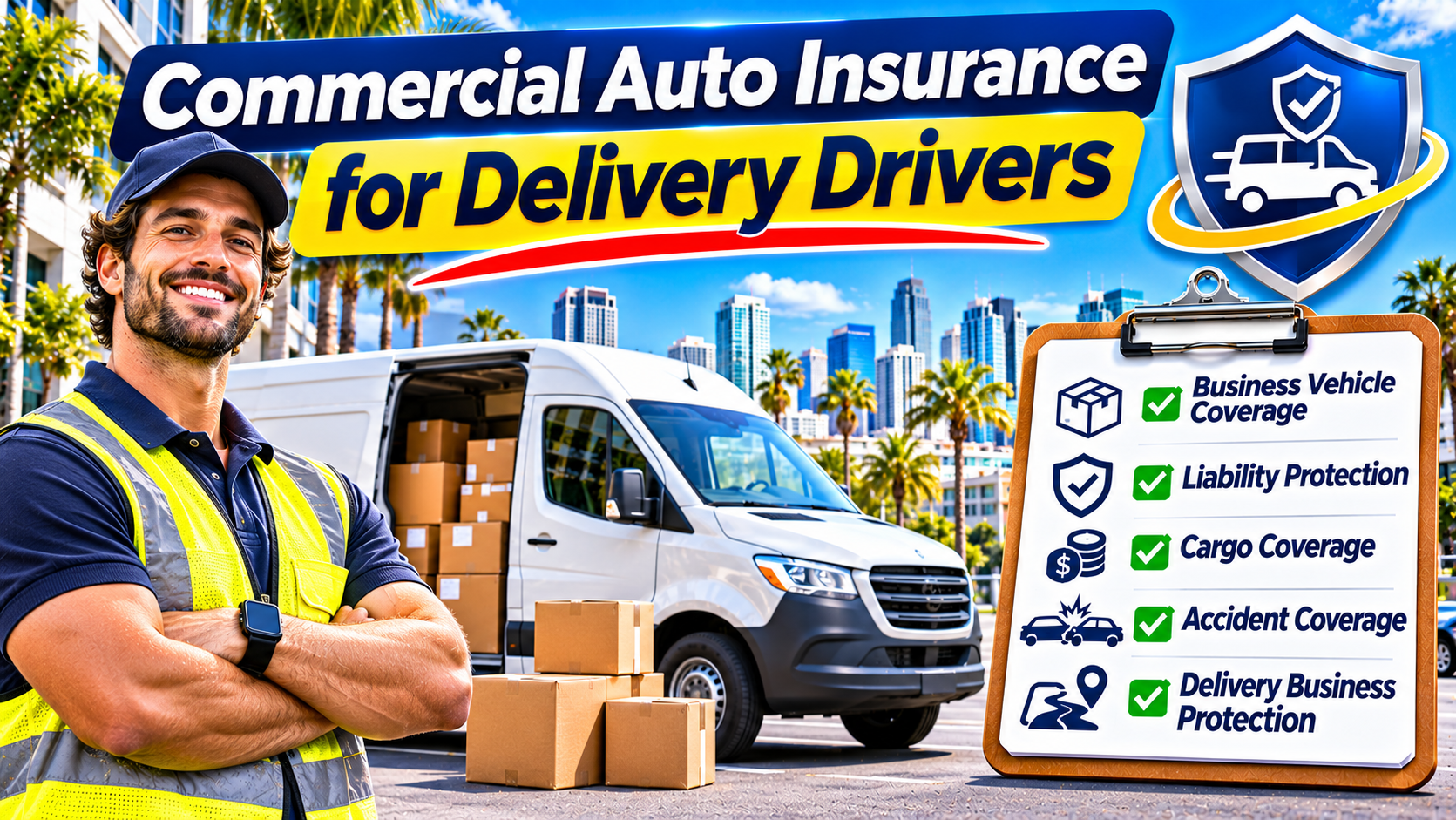
Commercial auto insurance for delivery drivers helps protect businesses and drivers against certain financial losses arising from vehicle accidents during delivery operations. Whether you deliver food, packages, groceries, or commercial goods, using a vehicle for business can create insurance risks that an ordinary personal auto policy may not adequately cover.
However, not every delivery driver needs the same type of commercial policy. The appropriate insurance depends on vehicle ownership, employment status, delivery activities, state requirements, and the terms of any coverage provided by a delivery platform or employer.
This guide explains when commercial auto insurance may be necessary, what it covers, how premiums are determined, and how independent contractors and delivery businesses can compare suitable policies.
Do Delivery Drivers Need Commercial Auto Insurance?
Quick Answer: Delivery drivers may need commercial auto insurance, a delivery-use endorsement, or another insurer-approved form of business-use coverage. A standard personal auto policy may exclude or restrict coverage when a vehicle is used to deliver goods for compensation.
The correct coverage depends on the insurer’s rules, the driver’s activities, and any applicable employer or delivery-platform insurance.
Before accepting delivery work, drivers should disclose their intended vehicle use to their insurance provider and obtain written confirmation of what is covered.
1. What Is Commercial Auto Insurance?
Commercial auto insurance is designed to cover certain vehicles and liability risks associated with business operations.
Businesses commonly purchase commercial auto policies for vehicles used to transport employees, equipment, products, or other goods.
A commercial auto policy may provide coverage for:
- Bodily injury liability.
- Property damage liability.
- Collision damage.
- Comprehensive losses.
- Medical payments or other state-specific benefits.
- Uninsured or underinsured motorist losses.
- Certain additional insured vehicles or drivers.
Actual coverage depends on the policy form, endorsements, exclusions, and applicable state law.
Commercial vs. Personal Auto Insurance
| Feature | Personal Auto Insurance | Commercial Auto Insurance |
|---|---|---|
| Primary purpose | Personal vehicle use | Covered business vehicle use |
| Delivery activities | May be excluded or restricted | May be covered when properly classified |
| Business-owned vehicles | Often unsuitable | Commonly designed for these vehicles |
| Commercial liability limits | May be limited | Higher limits may be available |
| Employee drivers | Coverage depends on policy | Can be structured for eligible employees |
| Fleet coverage | Generally not the intended product | May be available |
A commercial policy is not automatically broader in every respect. Coverage must be reviewed carefully.
2. Why Personal Auto Insurance May Not Cover Deliveries
Many personal auto policies distinguish ordinary personal use from certain commercial activities.
Delivering food, groceries, packages, or merchandise for compensation may trigger exclusions or require additional coverage.
For example, a driver using a personal vehicle for paid deliveries could face a claim dispute if the insurer was not informed of the commercial activity.
However, coverage rules differ by insurer and state.
Some insurers offer endorsements specifically designed for certain delivery activities.
Important Questions to Ask Your Insurer
Before using your vehicle for deliveries, ask:
- Does my current policy cover paid delivery work?
- Is coverage available while waiting for an order?
- Am I covered while traveling to collect an order?
- Does coverage continue while transporting the delivery?
- Do I need a commercial policy or a special endorsement?
- Are there mileage, vehicle, or delivery-platform restrictions?
Request confirmation in writing.
3. Types of Delivery Drivers Who May Need Commercial Auto Insurance
Delivery operations differ significantly.
Food Delivery Drivers
Drivers delivering restaurant orders may need coverage that addresses their activities during different stages of a delivery.
A personal auto policy may not automatically cover food delivery for compensation.
Grocery Delivery Drivers
Grocery delivery can involve frequent stops, residential routes, and significant annual mileage.
Coverage should match the actual business use.
Package and Courier Drivers
Independent couriers may deliver documents, parcels, medical supplies, or commercial goods.
Vehicle type, cargo, and contractual insurance requirements can affect the appropriate policy.
Delivery Van Operators
Businesses using vans for regular delivery operations often need commercial auto insurance designed for business-owned or commercially used vehicles.
Local Delivery Businesses
Companies employing multiple drivers may need commercial auto policies with appropriate driver eligibility and vehicle schedules.
Independent Contractors
Contractors using personally owned vehicles should verify whether they need their own commercial coverage, an endorsement, or other arrangements.
4. What Does Commercial Auto Insurance Cover?
Commercial auto policies can include several forms of protection.
Bodily Injury Liability
May help pay covered injury-related claims when an insured driver is legally responsible for an accident.
Property Damage Liability
May help pay for covered damage to another person’s vehicle or property.
Collision Coverage
May help repair or replace an insured vehicle after a covered collision, subject to deductibles and policy limits.
Comprehensive Coverage
May cover qualifying non-collision losses such as theft, fire, vandalism, or certain weather-related damage.
Uninsured and Underinsured Motorist Coverage
May help protect against qualifying losses involving drivers with insufficient insurance, subject to state rules and policy terms.
Medical Payments or Personal Injury Protection
Availability and requirements depend on the state and policy.
Hired and Non-Owned Auto Coverage
Hired and non-owned auto liability insurance may help protect a business against certain liability claims arising from vehicles it rents, hires, or does not own but that are used for business purposes.
This coverage generally does not replace the driver’s personal insurance or automatically pay for damage to the driver’s own vehicle.
5. Does Commercial Auto Insurance Cover Delivery Packages?
Not necessarily.
Commercial auto insurance primarily addresses vehicle-related risks and specified liability exposures.
It does not automatically insure the value of packages, merchandise, or cargo being transported.
Businesses transporting valuable goods may need separate coverage, such as:
- Motor truck cargo insurance.
- Inland marine insurance.
- Other specialized goods-in-transit coverage.
Coverage depends on the goods, business operations, policy terms, and contractual obligations.
For example, a delivery business transporting expensive electronics may need cargo protection in addition to commercial auto liability insurance.
6. Commercial Auto Insurance for DoorDash, Uber Eats, and Other Delivery Apps
Drivers working through delivery platforms should carefully review both their personal insurance and the platform’s current insurance arrangements.
DoorDash Drivers
DoorDash describes certain third-party liability coverage that may apply during qualifying active deliveries, subject to conditions and exclusions.
This coverage should not be assumed to replace personal auto insurance or provide comprehensive and collision protection for the driver’s own vehicle.
Uber Eats Drivers
Uber maintains insurance arrangements that vary by jurisdiction, vehicle type, and activity.
Drivers should review the current terms applicable to their location and delivery activity.
Other Delivery Platforms
Insurance arrangements for grocery and package delivery platforms may differ.
Some provide limited liability coverage during specific activities, while others require drivers to maintain their own qualifying insurance.
Why Delivery Status Matters
Coverage may change depending on whether a driver is:
- Offline.
- Logged into an app and waiting for an order.
- Traveling to collect an order.
- Transporting an order.
- Completing a delivery.
Do not assume that coverage applies equally at every stage.
7. How Much Does Commercial Auto Insurance Cost for Delivery Drivers?
Commercial auto insurance costs vary widely.
There is no reliable universal premium for every delivery driver.
A sole proprietor using one passenger vehicle for local food deliveries has a different risk profile from a courier company operating multiple commercial vans.
Factors Affecting Premiums
| Factor | Why It Matters |
|---|---|
| Vehicle type | Repair costs, size, and commercial classification |
| Delivery activity | Food, packages, specialty goods, or other cargo |
| Annual mileage | Greater vehicle use may increase exposure |
| Driving records | Accidents and violations may affect premiums |
| Operating territory | Local traffic and claims experience |
| Number of drivers | More drivers may change total risk |
| Coverage limits | Higher limits may increase premiums |
| Deductibles | Higher physical damage deductibles may reduce costs |
| Claims history | Previous losses can affect underwriting |
| Fleet size | Multiple vehicles change total insurance needs |
Illustrative Premium Example
Consider two hypothetical quotes for the same delivery vehicle:
| Coverage Arrangement | Illustrative Monthly Premium |
|---|---|
| Basic commercial liability | $170 |
| Commercial liability with collision and comprehensive | $285 |
These figures are fictional examples for explaining coverage comparisons. They are not current market averages, insurer quotations, or estimates for a particular state.
The actual difference may be substantially larger or smaller.
8. Best Commercial Auto Insurance Companies for Delivery Drivers
Several established insurers may be worth investigating.
However, no single company is the best or cheapest for every delivery operation.
| Insurance Provider | Potential Use Case | What to Verify |
|---|---|---|
| Progressive Commercial | Business vehicles and commercial auto policies | Delivery classification and eligibility |
| GEICO Commercial | Certain small-business auto insurance needs | Available policy options in your state |
| State Farm | Local agent-supported business insurance | Delivery use and underwriting acceptance |
| Nationwide | Commercial vehicles and business insurance | Coverage and territorial availability |
| The Hartford | Eligible commercial business operations | Vehicle and industry eligibility |
| Travelers | Commercial vehicle and fleet-related risks | Business classification and policy terms |
This list is a research shortlist, not a verified ranking based on current premiums.
Some insurers may not cover certain delivery activities, vehicle types, or independent contractors.
What Makes an Insurer Suitable?
Look beyond the advertised premium.
Compare:
- Whether your exact delivery activity is covered.
- Liability limits.
- Vehicle physical damage coverage.
- Exclusions.
- Deductibles.
- Driver eligibility.
- Claims service.
- Commercial vehicle requirements.
- Financial strength.
- Total annual cost.
9. Commercial Auto Insurance vs. Hired and Non-Owned Auto Insurance
These products address different risks.
Commercial Auto Insurance
Often used for vehicles owned by a business or otherwise specifically insured for commercial operations.
Hired and Non-Owned Auto Insurance
Often used by businesses that face liability exposure when employees or contractors use rented or personally owned vehicles for company activities.
Example
A restaurant employs drivers who deliver food using their own vehicles.
The restaurant may need hired and non-owned auto liability coverage to address certain business liability exposures.
However, each driver may still need suitable vehicle insurance covering delivery use.
A business’s hired and non-owned auto policy does not automatically provide the driver with full personal vehicle protection.
10. Commercial Auto Insurance Requirements by State
Commercial auto insurance requirements vary across the United States.
The correct requirements depend on vehicle registration, business operations, vehicle weight, cargo, interstate activity, and other factors.
California
Delivery businesses should evaluate California’s financial responsibility requirements and any additional commercial vehicle obligations.
Texas
Texas businesses should review the state’s applicable motor vehicle liability requirements and any special commercial requirements.
Florida
Florida’s basic private passenger vehicle insurance framework does not necessarily describe all requirements applicable to commercial vehicles or delivery operations.
New York
New York businesses should evaluate state-specific insurance requirements, vehicle classification, and commercial use.
Interstate Delivery Operations
Certain interstate commercial motor carriers may be subject to federal financial responsibility requirements administered by the Federal Motor Carrier Safety Administration (FMCSA).
Federal requirements do not apply identically to every local delivery driver.
11. How to Find Cheap Commercial Auto Insurance for Delivery Drivers
Lowering premiums should not mean leaving essential business risks uninsured.
Compare Multiple Quotes
Request quotes from insurers that accept your delivery activity and vehicle type.
Describe Your Business Accurately
Tell insurers what you deliver, how frequently you drive, and whether you transport goods across state lines.
Incorrect classifications can create serious coverage problems.
Consider Appropriate Deductibles
Higher physical damage deductibles may reduce premiums, but increase out-of-pocket costs after a claim.
Maintain Favorable Driving Records
Accidents and violations can affect premiums and eligibility.
Review Driver Eligibility
Businesses should establish appropriate driver qualification and safety practices.
Evaluate Fleet Management
For businesses with multiple vehicles, driver training, maintenance records, and route management may support better risk control.
Review Coverage Annually
Business operations change.
Reevaluate coverage when adding vehicles, hiring drivers, expanding routes, or transporting different goods.
12. How to Get Commercial Auto Insurance Quotes Online
Follow these steps when comparing coverage.
Step 1: Identify your business structure.
Determine whether you operate as an independent contractor, sole proprietor, or company with employees.
Step 2: List your vehicles.
Prepare vehicle identification numbers, registration information, and ownership details.
Step 3: Describe delivery activities.
Specify the goods transported, delivery radius, mileage, and operating locations.
Step 4: Identify drivers.
Provide accurate information about eligible drivers and their driving histories.
Step 5: Select coverage.
Choose appropriate liability limits, physical damage coverage, and optional protections.
Step 6: Request quotes.
Compare multiple authorized insurers or work with a licensed commercial insurance broker.
Step 7: Review exclusions.
Confirm that your specific delivery activities are not excluded.
Step 8: Confirm coverage dates.
Make sure qualifying insurance is active before beginning deliveries.
13. Common Insurance Mistakes Delivery Drivers Should Avoid
Assuming Personal Insurance Covers All Deliveries
Some personal policies exclude or restrict paid delivery work.
Relying Entirely on App Insurance
Platform coverage may apply only during specific activities and may not protect your own vehicle.
Ignoring Cargo Insurance
Vehicle insurance does not automatically cover the goods being transported.
Buying the Wrong Business Classification
Misrepresenting delivery operations may create claim disputes.
Choosing Only Minimum Limits
Minimum liability limits may be insufficient for serious accidents or commercial contracts.
Overlooking Employee and Contractor Risks
Business owners should evaluate how vehicles are owned, driven, and used.
Frequently Asked Questions
Do delivery drivers need commercial auto insurance?
Some delivery drivers need commercial auto insurance, while others may qualify for a delivery-use endorsement or another insurer-approved arrangement. Requirements depend on the vehicle, activity, insurer, and jurisdiction.
Does personal car insurance cover food delivery?
Not always. Personal auto policies may exclude or restrict delivery work performed for compensation. Confirm coverage with your insurer.
How much is commercial auto insurance for delivery drivers?
Premiums vary based on vehicle type, driving history, delivery activity, mileage, location, and coverage limits. Request actual quotes for accurate pricing.
Does DoorDash provide car insurance?
DoorDash describes certain liability coverage for qualifying active deliveries, subject to conditions. Drivers should verify current platform terms and maintain suitable insurance.
Does Uber Eats provide insurance for drivers?
Uber’s insurance arrangements depend on location, vehicle type, and delivery activity. Review the current terms for your situation.
Is commercial auto insurance required for independent contractors?
Not universally. Independent contractors must ensure their vehicle use is properly insured, but the appropriate policy or endorsement varies.
Does commercial auto insurance cover packages?
Not automatically. Separate cargo or goods-in-transit insurance may be necessary.
What is hired and non-owned auto insurance?
It is liability coverage designed for certain business exposures involving rented, hired, or non-owned vehicles used for business activities.
Can I get commercial auto insurance with an accident on my record?
Potentially. Eligibility and premiums depend on the insurer, driving history, business operations, and underwriting requirements.
What is the cheapest commercial auto insurance for delivery drivers?
There is no single cheapest provider for every driver or business. Compare quotes for equivalent coverage from insurers that accept your exact delivery operations.
Final Thoughts
Choosing commercial auto insurance for delivery drivers requires more than finding the lowest monthly premium.
Drivers and businesses should first confirm whether their vehicles are covered during paid deliveries, identify any gaps in platform or employer-provided protection, and evaluate appropriate liability and physical damage coverage.
Independent contractors may need different arrangements from companies operating delivery vans or commercial fleets.
Before purchasing, compare quotes from authorized insurers and obtain written confirmation that your specific delivery activities are covered.
The best policy is one that matches your actual operations and provides appropriate protection at a sustainable cost.
Leave a Reply